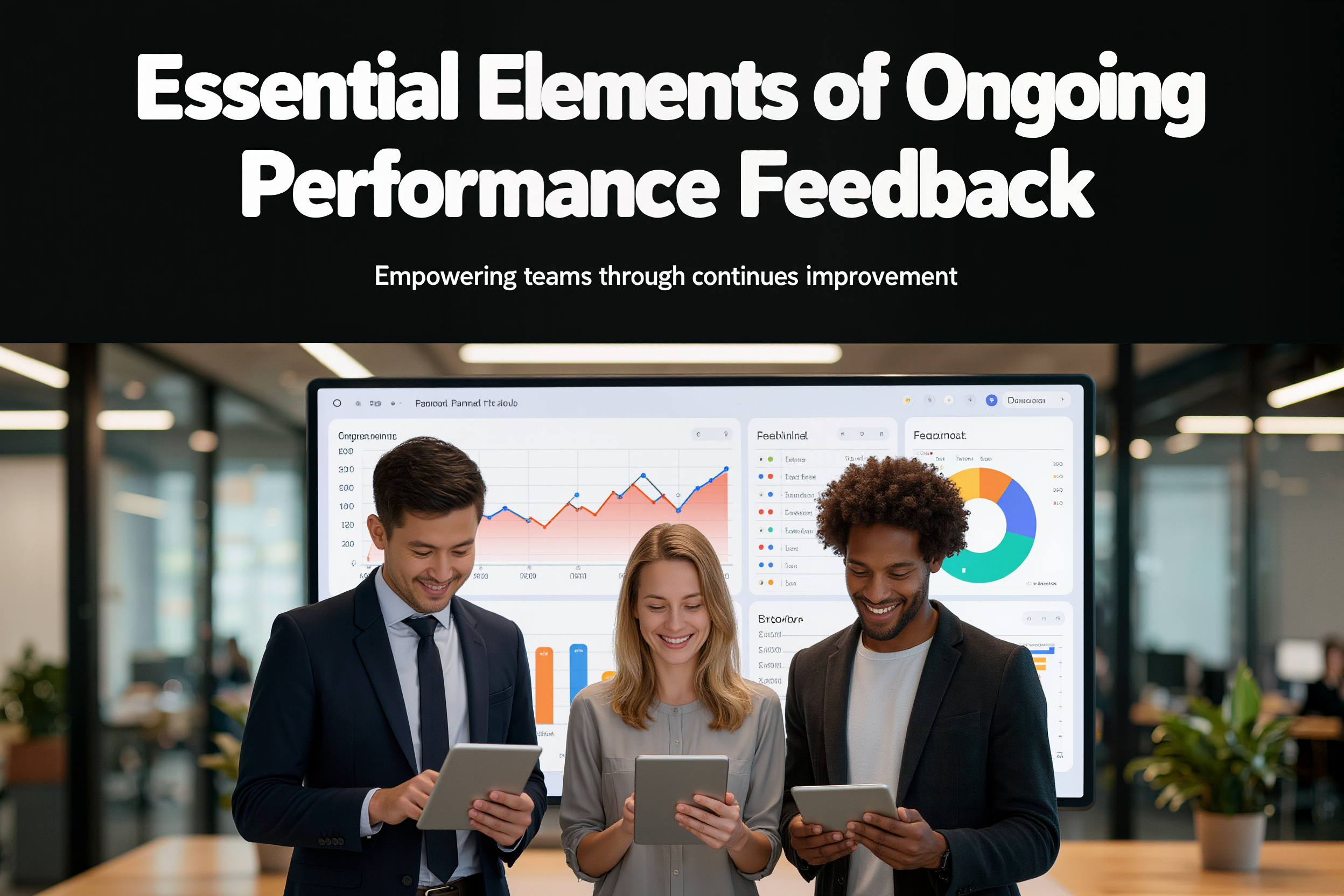
Essential Elements of Ongoing Performance Feedback – A Mixed-Methods Exploration
By Dr. Rico Poon, Ph.D. August 03, 2025
Abstract
Performance feedback is a cornerstone of human resource management, yet traditional annual appraisals often fail to address the dynamic needs of modern organizations. This study uses a sequential exploratory mixed-methods design to identify the essential elements of Ongoing Performance Feedback (OPF)—regular, real-time communication that enhances day-to-day work activities, employee engagement, and organizational goal alignment.
Key Finding: Quantitative data from 146 participants showed positive effects of OPF elements such as informal meetings and constant communication. Qualitative interviews with 15 participants identified 14 emergent themes, including constructive conversations, real-time problem identification, and the need for training.
In today’s fast-paced business environment, effective performance management is essential for organizational success. Traditional performance appraisals, usually conducted annually or semiannually, have been criticized for being disconnected from daily work activities. This disconnection can contribute to employee demotivation and inefficiency.
Ongoing Performance Feedback (OPF) offers a promising alternative. OPF is defined as continuous, informal exchanges between managers, employees, and peers. It provides real-time insights, strengthens employee engagement, and helps align individual efforts with organizational goals.
Literature Review
Performance Appraisal and Its Limitations
Performance appraisal involves the systematic evaluation of employee performance against predefined criteria. While traditional appraisal systems remain important in performance management, they can also produce negative consequences, including bias, delayed feedback, and disconnection from daily work responsibilities.
Ongoing Performance Feedback
OPF shifts performance management away from episodic reviews and toward continuous communication. Rather than waiting for an annual evaluation, OPF uses regular conversations and real-time information to support employee improvement, interpersonal relationships, and alignment with changing organizational goals.
Employee Engagement and Organizational Goal Alignment
Employee engagement includes cognitive, emotional, and behavioral commitment to organizational outcomes. OPF can strengthen engagement by providing recognition, motivation, and clarity. Goal alignment connects individual work to organizational strategy, supported by clear expectations and timely feedback.
Methods
Research Design
This study used a sequential exploratory mixed-methods approach, beginning with quantitative surveys to identify patterns, followed by qualitative interviews to provide deeper insight. This design allowed statistical findings to be integrated with participant narratives.
Participants
Phase 1: 146 U.S.-based professionals participated in the quantitative survey.
Initial responses: 173 responses were collected and cleaned for analysis.
Participant criteria: Adults aged 18 and older with at least two years of performance appraisal experience.
Demographics: Participants included diverse job levels, 55% female, with a mean age of 43.
Phase 2: 15 participants were selected for qualitative interviews.
Instrumentation and Procedures
The quantitative phase used a 51-item Likert-scale survey to assess OPF elements. The survey was developed from the literature and piloted, with reliability measured at Cronbach’s α greater than 0.80. The qualitative phase included semi-structured Zoom interviews lasting approximately 30 to 45 minutes.
Data Analysis
Quantitative data were analyzed using descriptive statistics, multiple regressions, and one-sample t-tests. Qualitative data were analyzed through thematic analysis, which produced 14 emergent themes. The results were integrated narratively during interpretation.
Results
Quantitative Findings
The findings showed strong agreement with the benefits of OPF. OPF elements, including constant communication, significantly predicted day-to-day work activities, employee engagement, and organizational goal alignment.
Statistical Findings
Day-to-day work activities: R² = 0.38, p < 0.001
Employee engagement: R² = 0.42, p < 0.001
Goal alignment: R² = 0.45, p < 0.001
Elements such as informal meetings exceeded neutral thresholds, p < 0.001
Qualitative Findings
Qualitative interviews revealed themes that helped explain how OPF supports employees in real workplace settings. Participants described OPF as improving daily motivation, trust, and alignment with organizational priorities.
Constructive conversations
Real-time problem identification
Informal meetings
Constant communication
Brief interactions
Training needs
Discussion
The findings support the conclusion that OPF positively impacts day-to-day work, engagement, and goal alignment. Informal meetings and training emerged as important elements. Constructive conversations helped employees make real-time adjustments, while consistent recognition supported engagement and motivation.
The study also contributes to the performance management literature by identifying 14 themes that emphasize brevity, informality, and practical communication over rigid formal structures.
Practical Implications
Use regular check-ins to support ongoing communication and accountability.
Encourage informal feedback conversations to strengthen trust and performance clarity.
Provide feedback training for managers, employees, and peers.
Shift from annual-only reviews toward continuous performance conversations.
Connect feedback to organizational goals so employees understand how their work contributes to broader outcomes.
Limitations and Future Research
This study used convenience sampling, which may limit generalizability. Self-report bias may also have influenced participant responses. Future studies should replicate the research in single organizations, use longitudinal approaches, and explore cultural variations in feedback practices.
Conclusion
Ongoing Performance Feedback represents a transformative approach to performance management for modern organizations. By incorporating elements such as constant communication, informal meetings, constructive conversations, and training, organizations can improve productivity, engagement, and strategic alignment.
Ongoing Performance Feedback helps organizations move from delayed evaluation to real-time development, communication, and alignment.
This study provides a foundation for evidence-based performance management practices and encourages broader adoption of ongoing feedback systems within organizations.


 By Dr. Rico Poon, Ph.D.
August 03, 2025
By Dr. Rico Poon, Ph.D.
August 03, 2025